 Machine de soudage au laser

Qu'est-ce que le marquage laser? Dans cet article, we will explore what a laser marking machine is and how it works.
Laser marking machine is a permanent marking process that uses a focused laser beam to create text, logos, serial numbers, barcodes, QR codes, and graphics on a material surface. Aujourd'hui, laser marking technology is widely used across manufacturing industries because it delivers high precision, excellent durability, and fast processing speed.
As global manufacturing continues to move toward automation and smart production, laser marking systems have become increasingly important. En fait, many companies now replace traditional printing, ink coding, and mechanical engraving methods with modern laser marking machines.
De plus, laser marking creates permanent marks without physical contact. Par conséquent, manufacturers can improve product traceability while reducing maintenance costs.
Donc, laser marking has become one of the most reliable identification technologies available in modern industrial production.
How Does Laser Marking Work?
Laser marking works by directing a concentrated laser beam onto a material surface. The laser energy changes the material through heat, oxidation, color change, or material removal.
Unlike traditional marking methods, laser marking does not require inks, chemicals, or mechanical tools. Plutôt, the laser beam performs the marking process directly.
As the laser interacts with the surface, it creates clear and permanent markings. En outre, advanced control software allows manufacturers to generate highly detailed graphics and codes with excellent accuracy.
Because the process is digitally controlled, laser marking machines can achieve consistent results even during high-volume production.
En outre, automated laser marking systems can integrate with robotic arms, conveyor systems, et Industrie 4.0 manufacturing platforms.
Consequently, laser marking technology supports both efficiency and scalability.
Why Laser Marking Is Important in Modern Manufacturing
In today’s competitive manufacturing environment, product identification is more important than ever.
Manufacturers must track products throughout the supply chain. En même temps, they must comply with quality control standards, industry regulations, and customer requirements.
Donc, permanent marking solutions are essential.
Laser marking provides several important advantages:
- Permanent identification
- High-speed processing
- Excellent readability
- Minimal maintenance
- Environmental sustainability
- Easy automation integration
En outre, laser marking supports anti-counterfeiting efforts by creating unique serial numbers and traceable product information.
Par conséquent, industries worldwide continue to increase investments in laser marking technology.
Main Types of Laser Marking Technology
Not all laser marking methods are identical. Different applications require different marking technologies.
Donc, understanding the main laser marking processes helps manufacturers choose the right solution.
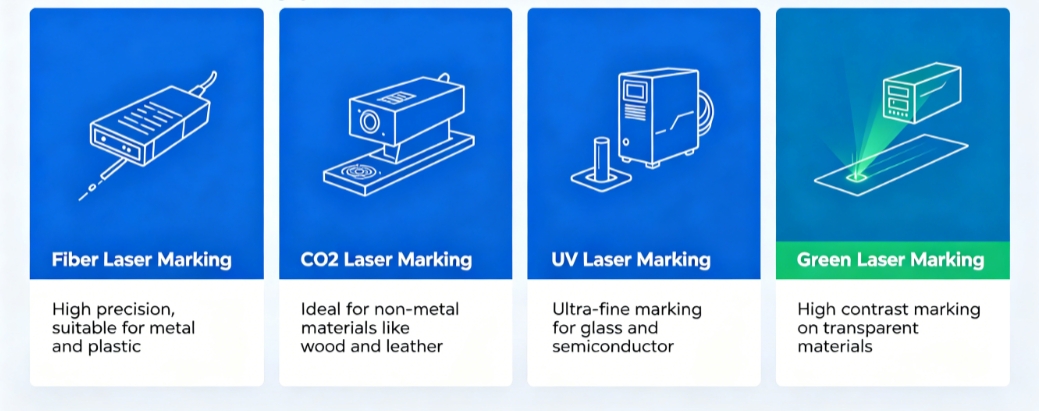
Main Types of Laser Marking Technology
Fiber Laser Marking
Fiber laser marking is one of the most popular industrial marking technologies.
Because fiber lasers generate highly concentrated energy, they perform exceptionally well on metal materials.
Common materials include:
- Stainless steel
- Aluminum
- Copper
- Brass
- Titanium
- Carbon steel
>En outre, fiber laser marking machines provide:
- High marking speed
- Longue durée de vie
- Faible entretien
- Excellente précision
- Haute efficacité énergétique
Consequently, fiber laser marking systems are widely used in automotive, aérospatial, électronique, and medical industries.
CO2 Laser Marking
CO2 laser marking systems are ideal for non-metal materials.
Par exemple, CO2 lasers commonly mark:
- Wood
- Leather
- Acrylic
- Paper
- Packaging materials
- Rubber
En outre, CO2 laser marking creates clean and attractive results on organic materials.
Donc, many packaging and consumer goods manufacturers choose CO2 laser technology.
UV Laser Marking
UV laser marking technology is designed for ultra-precise applications.
Unlike traditional laser systems, UV lasers generate less thermal impact.
Par conséquent, they are ideal for sensitive materials such as:
- Medical plastics
- Composants électroniques
- Glass
- Semiconductor products
De plus, UV laser marking reduces surface damage while maintaining exceptional precision.
Donc, high-tech industries frequently use UV laser systems for micro-marking applications.</p>
Advantages of La
ser Marking Machines
Laser marking technology offers many benefits compared with traditional marking methods.
Consequently, manufacturers continue to adopt laser systems at a rapid pace.
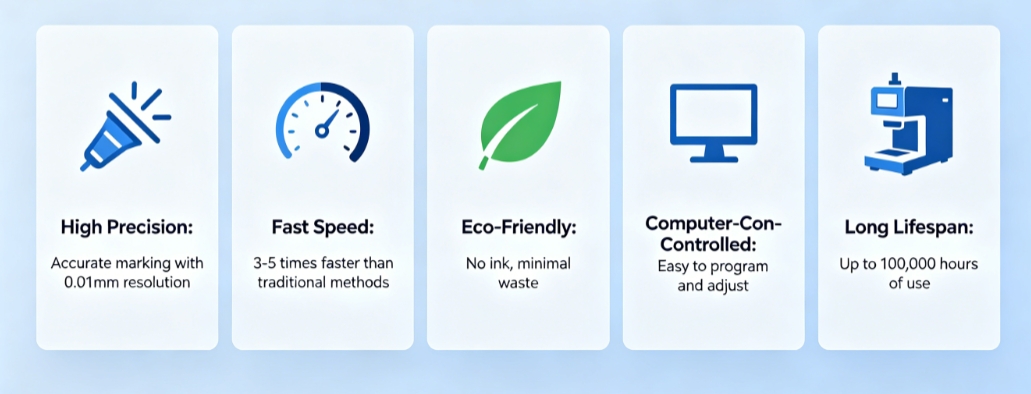
Permanent Marking Results
One of the biggest advantages of laser marking is permanence.
Unlike labels or ink printing, laser marks resist:
- Wear
- Heat
- Chemicals
- UV exposure
- Corrosion
Par conséquent, product information remains readable throughout the product lifecycle.
High Precision and Accuracy
Laser marking machines create extremely fine details.
Par exemple, manufacturers can mark:
- Tiny QR codes
- Complex logos
- Small serial numbers
- High-density barcodes
De plus, modern systems achieve micron-level precision.
Donc, laser marking is ideal for electronics and medical devices.
Fast Production Speed
Speed is another major benefit.
Because laser marking is highly automated, manufacturers can process thousands of parts per hour.
En outre, digital file changes occur instantly.
Par conséquent, production flexibility increases significantly.
Low Maintenance Costs
Traditional marking methods often require:
- Ink replacement
- Tool replacement
- Cleaning
- Frequent servicing
Cependant, laser marking machines require very little maintenance.
En outre, fiber laser sources can operate for more than 100,000 hours.
Donc, long-term operating costs remain relatively low.
Environmentally Friendly Production
Environmental regulations continue to tighten across Europe and North America.
Consequently, manufacturers seek greener production technologies.
Laser marking supports sustainability because it eliminates:
- Ink waste
- Chemical waste
- Solvents
- Consumable materials
Par conséquent, businesses can reduce environmental impact while maintaining production efficiency.
Laser Marking vs Laser Engraving
Many people confuse laser marking with laser engraving.
Although they are related technologies, they are not identical.
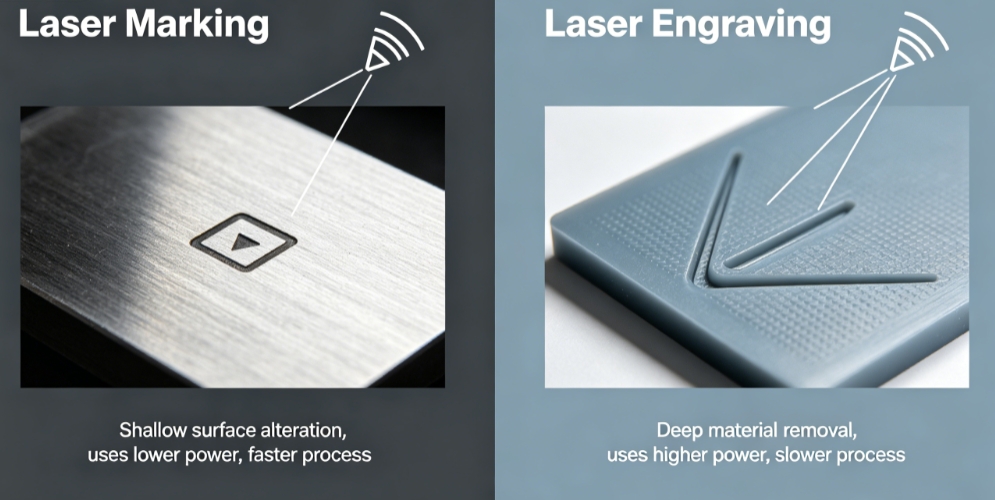
Laser Marking vs Laser Engraving
Marquage au laser
Laser marking changes the surface properties of a material without removing significant material.
Par conséquent:
- Surface remains smooth
- Processing speed is faster
- Material damage is minimal
Laser Engraving
Laser engraving removes material to create deeper markings.
Donc:
- Marks become more visible
- Depth increases
- Processing time is longer
Both technologies offer unique advantages. Cependant, laser marking is generally preferred for high-speed industrial traceability applications.
Industrial Applications of Laser Marking Technology
Laser marking supports a wide range of industries.
Because the technology is versatile, manufacturers use it across many production sectors.
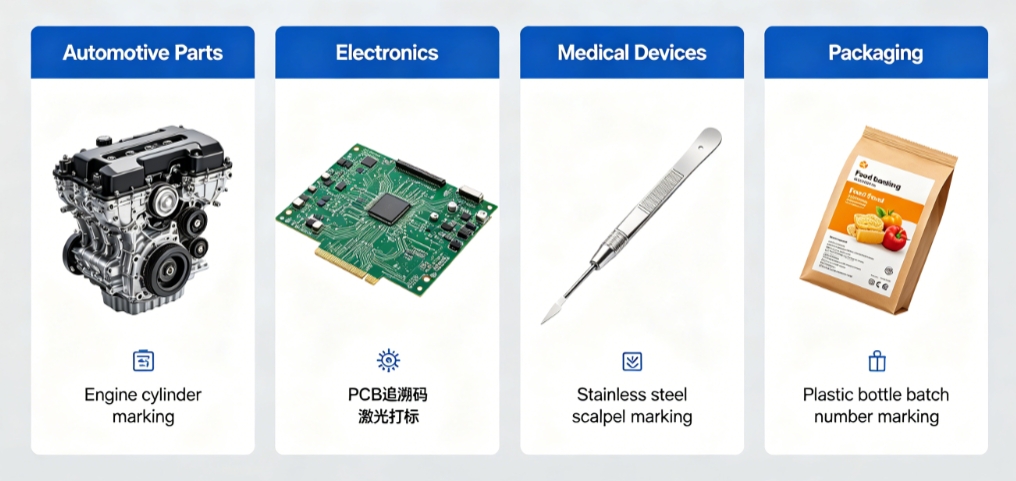
Industrial Applications of Laser Marking Technology
Automotive Industry
Automotive manufacturers use laser marking for:
- VIN numbers
- Engine parts
- Brake components
- Safety systems
- Metal identification plates
En outre, permanent markings improve traceability and regulatory compliance.
Aerospace Industry
Aerospace manufacturers require durable and highly accurate identification systems.
Donc, laser marking is used on:
- Aircraft components
- Turbine blades
- Structural parts
- Titanium assemblies
De plus, laser marking meets strict aerospace quality standards.
Medical Device Manufacturing
Medical devices require permanent identification.
Common applications include:
- Outils chirurgicaux
- Implants médicaux
- UDI codes
- Stainless steel instruments
Par conséquent, laser marking helps improve patient safety and product tracking.